
Three Dinwiddie Property Value Measures
Dinwiddie’s system aims to assess real estate at full fair market value. It applies as of an effective date. A mass-appraisal figure is a public tax record. It is not a personal appraisal for a sale, refinancing, or estate. A recorded sale price is a different clue entirely. It can diverge from the assessor’s value. It may reflect a partial interest or unusual terms that only deed review can untangle.
| Value | What It Is | Where |
|---|---|---|
| Assessed value | County mass-appraisal value used for the tax roll | Vision assessment database |
| Market value | The fair-market value concept used for Dinwiddie’s assessment level | County assessment methodology |
| Sale consideration | Value stated for a recorded transfer; read the deed context | Circuit Clerk deed instrument and Vision sales context |
| Tax bill amount | Assessment combined with a separately adopted rate and collection rules | Treasurer inquiry; not a value appraisal |
The current county reassessment took effect January 1, 2025. Vision reports that sales update daily, so a new sale can surface in sales information before the tax-roll value moves. The Board of Supervisors sets the tax rate separately, which means a higher assessed amount alone tells you nothing about the bill.
Dinwiddie Assesses at Full Market Value
Dinwiddie County appraises real property at 100 percent of fair market value. Virginia's constitution requires this standard. An assessment, though, is a mass appraisal. It draws on county data, neighborhood sales, land values, appreciation patterns, and property facts. The result is a consistent tax-roll value across parcels. It is not a prediction of sale price. No single buyer is bound by it. One house may sell above or below its assessed value on any given day.
Field labels vary by system. A parcel card may show land value, improvement value, exemption status, sale date, and prior values. Read the live record for its own numbers and context. The Dinwiddie Vision assessment portal is the official public entry point.
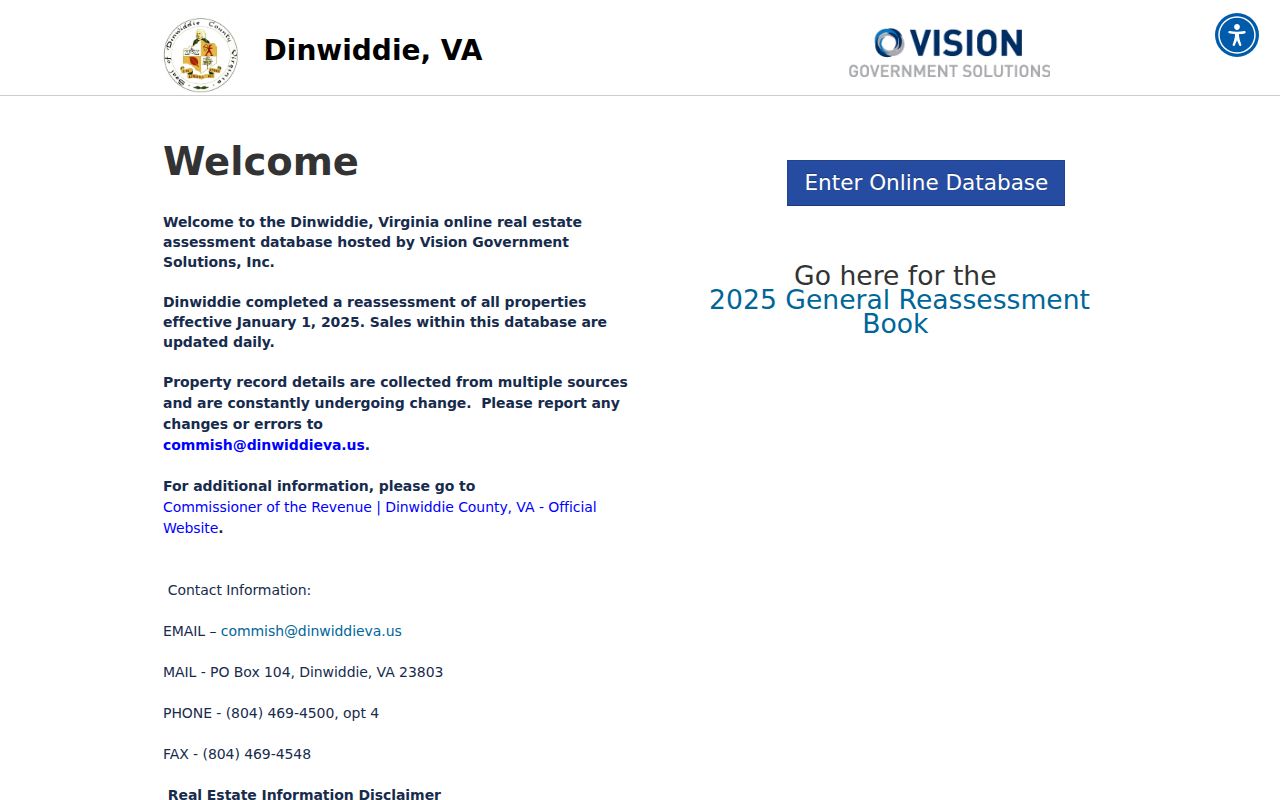
The landing screen lists the county’s reassessment and sales notices rather than any single property’s value fields.
Dinwiddie’s January 2025 Baseline
Dinwiddie County's current assessment results took effect January 1, 2025. A sale after that date can still be useful market evidence. But it does not rewrite the tax roll on the day it closes. Vision sales update daily, per the county. An assessment, in contrast, reflects its effective date and the county's valuation process. This timing gap explains why two official records can show different owner or value details. Neither one is wrong.
The next general reassessment takes effect January 1, 2027. Notices are expected in early fall 2026. The official real-estate book is scheduled for filing December 31, 2026. The Board of Equalization appeal deadline is February 16, 2027. Those dates concern valuation and review only. The Board of Supervisors sets the tax rate separately through its budget process. The county's general reassessment calendar shows the local cycle.
Compare the value’s effective date with the sale date before drawing any trend line.
Recorded Consideration Is Not Assessed Value
A recorded deed can state consideration. That is the amount or value tied to the transfer, and it belongs with the parties, legal description, date, and instrument type. The Clerk's recordation-tax rule uses stated consideration for an arm's-length sale. For foreclosure deeds and transfers between parties who know each other, the county uses the higher of assessed value or consideration.
That tax method does not convert consideration into a private appraisal. A gift, partial interest, estate conveyance, or court-related transfer may not resemble an ordinary full-parcel sale. The Vision sales feed can update daily without ever moving the assessment's effective date.
Check the recorded deed through the Clerk's land-record access for the transaction amount. Use Vision for the assessment. Keep the two values separate in any analysis.
Older Dinwiddie Values in Land Books
For historic property value, the county and the Library of Virginia preserve Dinwiddie land books from 1782 through 1885. The books are annual PDFs. A land book can show a landholder and tax assessment in a given year. That makes it useful for tracking a parcel's recorded owner and value over time. It is not a deed, appraisal, or exact reconstruction of modern boundaries.
The Clerk also lists land-tax records and compiled grant and patent material. Pre-1833 land records were destroyed. These sources matter for property history before the surviving deed chain begins. Test any match with a historic plat or legal description against the current parcel. The county's genealogical research page describes the surviving books and local copy access.
Value and Dinwiddie Tax Rates Differ
An assessed value in Dinwiddie County is only part of the story. The Board of Supervisors sets the tax rate each year during the budget process. The Treasurer then collects what the tax roll says is owed. So a higher assessment does not lock in a higher bill. Rates can move in either direction, and the two figures interact.
Parcels inside the McKenney charter boundary carry an added town tax. That extra layer changes the total owed without touching the county assessment at all. For billing dates, relief programs, payment history, and appeal deadlines, the county tax record page holds the detail. The value question comes down to what each number means. Where the county records it matters just as much.
Look Up a Dinwiddie Assessed Value
The county's Vision assessment database is the tool for the job. Search by owner name, property map number, or street to pull up the parcel. Save the map key once you have it. That number is worth keeping handy. It lets you line the assessment up against the latest deed and the GIS parcel.
- Search Vision with a known owner, map number, or street name.
- Record the value and any effective-date or sales context displayed by the parcel record.
- Check the latest deed for any stated consideration and recording date.
- Compare only records that describe the same parcel and distinguish assessment from sale information.
- Assessed value
- The county’s value for taxation under its assessment process.
- Market value
- The fair-market concept used to set Dinwiddie’s assessment level.
- Consideration
- The amount or value stated in a deed for a transfer.
- Reassessment
- A county-wide update that establishes new assessment values at an effective date.
What a Dinwiddie Value Does Not Say
A Dinwiddie assessed value comes from mass appraisal. That makes it a tax-roll figure rather than a precise number for one house. It is not a licensed appraisal, an offer, a guaranteed sale price, or a title report. Timing matters too. The county relies on a January assessment date and a daily sales note. So sale data and tax-roll data can reflect different moments in the same parcel's history.
Value vs price. An assessed value is for the county tax roll and may differ from what the property would sell for today. Use a licensed appraiser for an appraisal and the Treasurer for the bill.