
What Dinwiddie Deed Records Contain
Deeds, deeds of trust, releases, plats, judgments, and financing statements all pass through the Dinwiddie Circuit Court Clerk for entry in the deed books. Each instrument does a different job. A deed conveys an interest in land. A deed of trust creates a security interest, and a release or certificate of satisfaction shows that a prior debt was cleared. The Clerk records land electronically. Its published coverage table is the best guide to which years each record family offers, so start there before assuming a series runs complete.
| Deed Type | What It Does | Common Use |
|---|---|---|
| Deed of conveyance | Transfers the interest stated in the instrument | Sale, gift, family transfer, or other conveyance |
| Deed of trust | Creates a secured loan interest in land | Financing recorded with the Clerk |
| Release or satisfaction | Records a release of a prior secured claim | Confirm a debt instrument was later cleared |
| Executor or commissioner deed | Conveys land under an estate or court process | Probate, chancery, or judicial sale |
| Special warranty deed | Conveys the seller’s stated interest with limited warranties | County tax sale after court confirmation |
Labels can mislead. A deed's true effect shows in the granting clause, the parties, the legal description, the exceptions, and any instruments it references. Dinwiddie's Clerk indexes the document, but the deed alone cannot tell you whether a later release, court order, easement, or unrecorded claim touches the parcel.
Dinwiddie Land-Record Years by Series
Dinwiddie's published coverage table reaches far back. Land records run from 1833 to the present, and plats from 1910 forward. Judgments appear from 1987. Financing statement indexes begin in October 2000, and their images in December 2006. Wills and fiduciary material show a discrepancy between county displays. One listing lists an index from 1830, and another from 1989. Ask the Clerk to confirm the right run for a specific estate file. The county coverage screen sets out these separate date ranges. It also notes the Social Security number redaction work. It is linked at the Dinwiddie land-records office page.
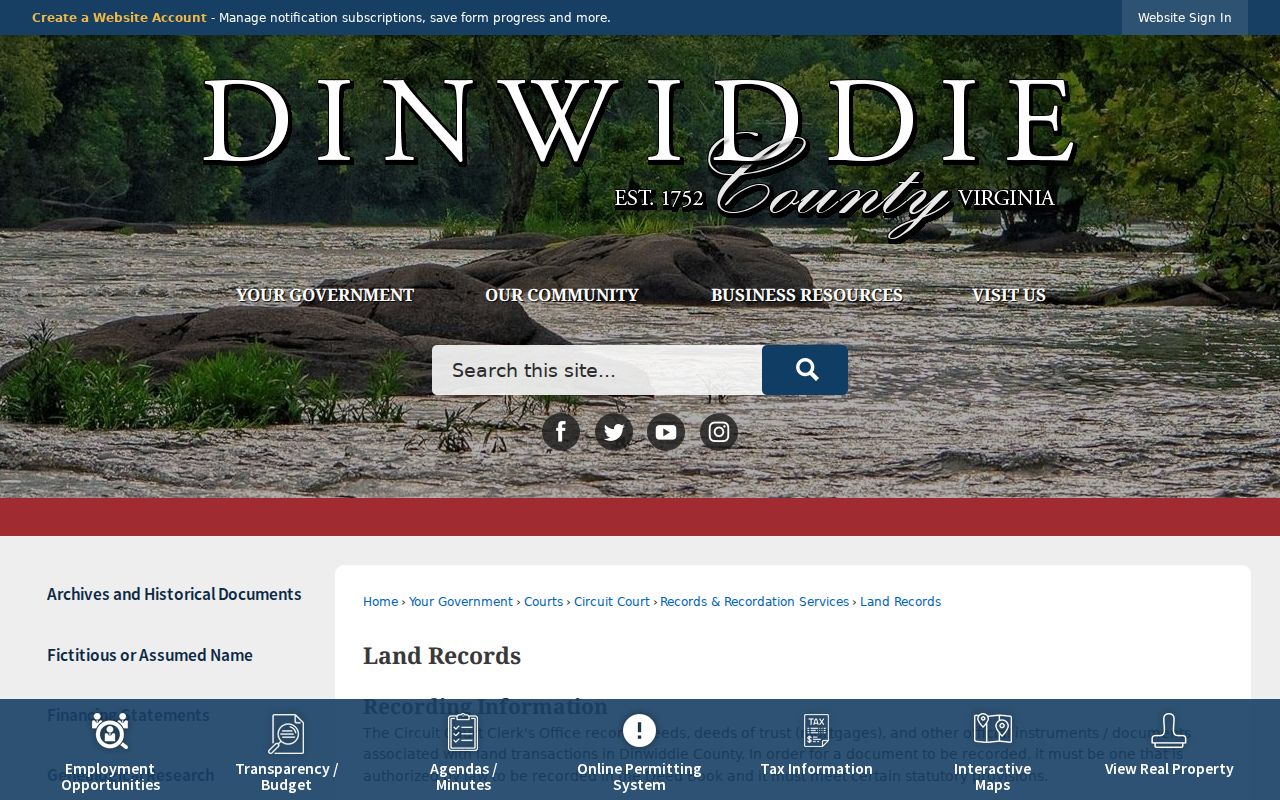
Check the row for the record type. Never assume every index and image starts in the same year.
Search the Dinwiddie Grantor Index
The grantor-grantee index sorts deeds by the parties to a recorded transfer. The grantor gives up an interest; the grantee receives it. The public SRA landing screen does not expose the live field labels or result columns, so lean on the Clerk's coverage page and the search result itself when framing a real request. When a result appears, save the party spelling, record date, book or page reference, and instrument type.
- Use Vision or a current deed to learn the likely owner name and parcel description.
- Search the owner as grantee to find the deed by which the person or entity acquired the land.
- Read that instrument to identify the grantor, then search the grantor as an earlier grantee.
- Repeat only as far as the research question requires, checking later releases and court instruments along the way.
- Grantor
- The party conveying an interest in the instrument.
- Grantee
- The party receiving the interest described in the instrument.
- Chain of title
- The ordered series of recorded conveyances associated with a parcel.
- Book and page
- A volume reference used to locate a recorded document; other systems may use a document number.
The Virginia SRA/COVERS portal hosts Dinwiddie land records.
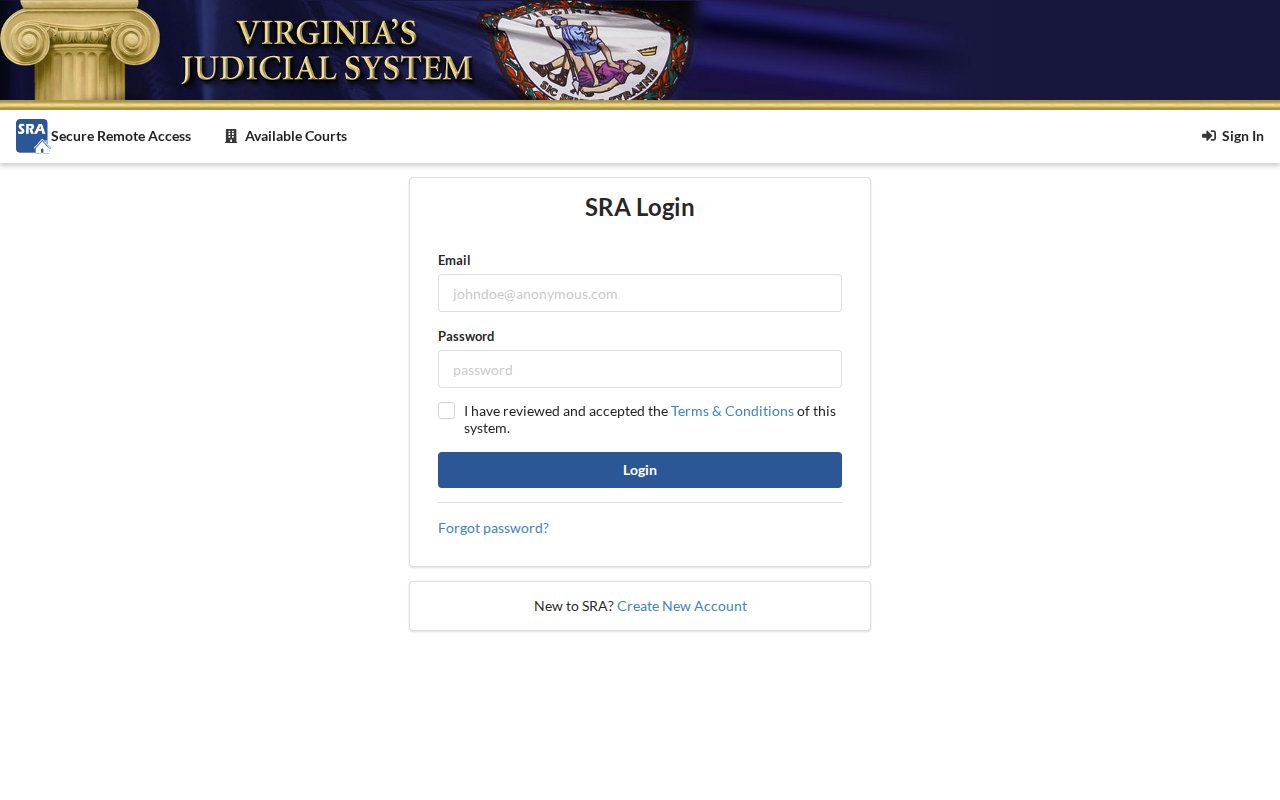
The captured page shows the access route, not an inspected Dinwiddie deed result.
Dinwiddie Deeds Before and After 1833
Not everything survived. The county warns that land records before 1833 were burned at the end of the Civil War. Deed Book 1 covers 1833 through 1837. The Library of Virginia lists the later early books plus a general index for 1833 to 1889, and its microfilm guide includes grantor indexes by surname through 1976. Treat these as research leads. Each item is not promised as a current web image.
For the lost period, piece together ownership from land books, tax records, patents, grants, and plats. Land books record owners and assessments, not full conveyance terms. A later deed may point back to an earlier tract. Still, label the surviving chain incomplete wherever the instrument itself is missing. The Library of Virginia Dinwiddie microfilm guide lists the deed books and indexes, and its finding aid links the online description with reels and related local records.
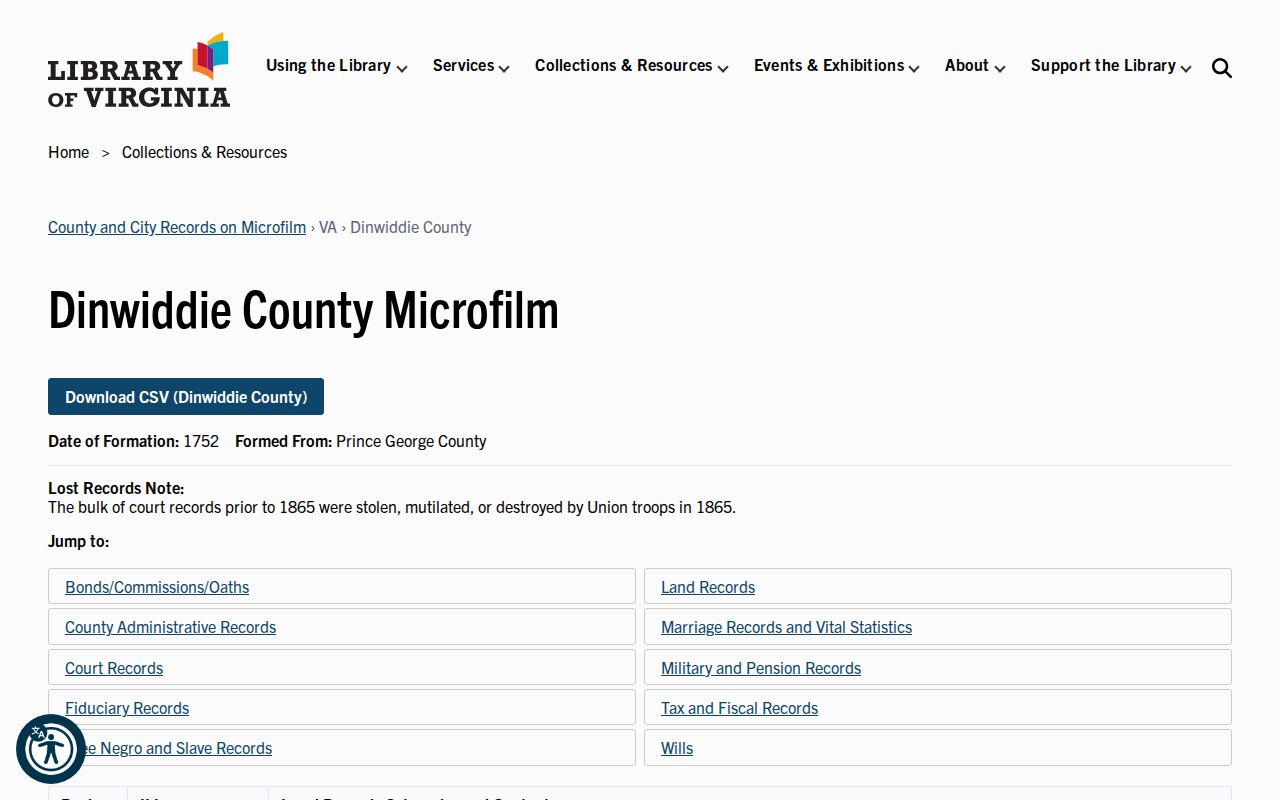
When title evidence stops before 1833, draw on several surviving sources. Explain the gap, and never treat a land-book entry as a deed.
Get a Dinwiddie Deed Copy
A deed image may not be available through a clerk-authorized SRA account. In that case, the Circuit Court Clerk accepts copy requests by email, mail, or in person. The county's genealogy instructions list an emailed copy charge of $5 per document. A $2 per-document certificate fee and $0.50 per page also apply. Mail copies run $0.50 per page plus $2 per document for certification. Confirm the current fee and the certification you want before sending payment.
A mail request should name the document. It should include a check or money order payable to the Dinwiddie County Circuit Court Clerk, and carry a stamped self-addressed return envelope. The published records-room mailing location is P.O. Box 63, Dinwiddie, Virginia. Phone the Clerk at (804) 469-4540 if the reference is uncertain. Office hours are weekdays, 8:30 a.m. to 4:30 p.m. A certified copy is an authenticated copy, not a title search.
For an online route, the Clerk points researchers to county online record services. Decide whether the item you want is a land record, court file, archive record, or payment. Then choose a portal.
Recordation Tax Clues in Dinwiddie
Dinwiddie's recordation-tax rules offer a clue to what a deed was worth. An arm's-length sale is taxed on its stated consideration. Foreclosure deeds work differently. So do deeds between parties who know each other. For those, the county taxes the higher of the assessed value or the consideration. That is a tax rule, not a market appraisal.
Consideration is the amount the deed reports as its transfer basis, and it can diverge from an assessment. It may also leave out parts of the deal. When you set a deed beside Vision sales information, compare the instrument date and the recording date, and check whether the deed covers a full parcel or only a partial interest. The recorder's page lays out this practice and links the state deed calculator. Use those numbers alongside the instrument, never in place of its granting and legal-description clauses.
Dinwiddie Recording Safeguards
Dinwiddie finished a major Social Security number redaction project in April 2008, under Va. Code §17.1-227. The Clerk will not knowingly record an instrument carrying a party's Social Security number. An online image may differ from the paper original, and the redaction notice explains why.
The county also runs VADeed Alert. That free service sends a notice when a local land-record document matches a watched name or Tax Map/Parcel ID. It cannot stop a recording. It cannot judge a filing's validity either. If an alert surprises you, the county says to review the recording with the Clerk and seek legal advice. Details live on the county's VADeed Alert page.
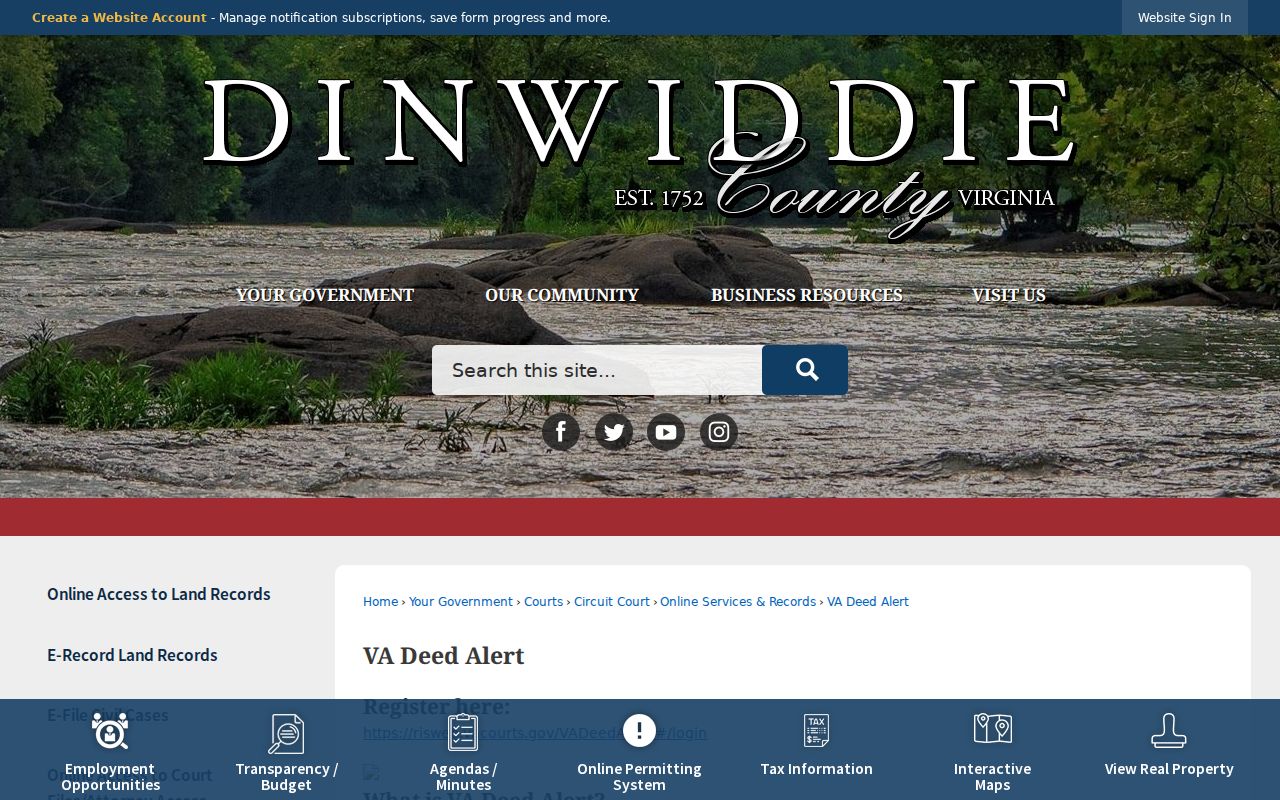
An alert prompts review; the recorded instrument remains the evidence.
Trace the Dinwiddie Grantor-Grantee Chain
Dinwiddie deed records are indexed by party names, so verify the names exactly as each instrument prints them. A parcel number alone won't trace the chain. Trustees, executors, heirs, and corporations all appear as parties. Search each alternate form when a person held Dinwiddie land in more than one capacity.
- Locate the most recent acquisition instrument for the owner or parcel.
- Read the grantor name and compare the deed description with the parcel being researched.
- Search the grantor as a prior grantee and repeat through earlier conveyances.
- Stop and use land books, microfilm, or archives when the trail approaches the pre-1833 loss.
- Grantor
- The party conveying the interest described in a deed.
- Grantee
- The party receiving that interest.
- Chain of title
- The linked sequence of recorded instruments affecting a parcel.
- Book/page or instrument number
- A clerk’s location reference for the recorded item; note the format shown in the index.
Request a Dinwiddie Deed Image
Before requesting a copy, gather the parties, instrument type, recording year, and any book/page or document reference. SRA may show an index line without image access. The local Clerk controls image subscriptions. When a title decision hangs in the balance, order the full instrument plus any related releases or court orders. A short index line proves little.
Recorded, not guaranteed. Dinwiddie deed records show instruments of record, not every possible claim or a guarantee of clear title. Use a qualified title professional for a title conclusion.